
12th May 2026
Your Church Has a Neighborhood. Does Your Building Know That?

Featuring insights from Zach Miller, Project Director at PlainJoe, a Storyland Studio
Consider two churches with similar congregation sizes and budgets, but serving very different communities. One is in a lower-income neighborhood where residents feel disconnected and underserved. The other is in an affluent suburb where families show up on Sunday but often struggle to feel genuinely known.
Different communities, different challenges. But in both cases, the building is already saying something to the people walking through the door, whether the church planned it that way or not. Does your building know what story it’s telling?

A Church Site Plan
Design Is a Diagnosis
Before any design work begins, PlainJoe asks a deceptively simple question: What broken story are the people in your community telling themselves?
People move through the world operating on often-unconscious beliefs: I belong here. I’m not alone. This place is safe. When those beliefs are damaged, they create quiet despair that shapes everything about how someone engages with a church.
“Every organization, every person at every moment is living in an internal narrative. And a big part of our conviction at PlainJoe is that everything speaks.”
–Zach Miller, Project Director, PlainJoe
That conviction is the foundation of PlainJoe’s approach: every design decision is a line in a story. The question is whether those lines are working together, telling one coherent, intentional narrative to the specific people walking through your doors, or pulling in different directions and leaving visitors to fill in the gaps themselves.
This is why every PlainJoe engagement begins with a Story Circle, a facilitated discovery process where the community’s narrative is surfaced before a single design decision is made. When we know what story people are already living in, we can build something that speaks directly to it.

Story Circle Meeting
Square Footage Is a Values Statement
Once the story is clear, design decisions stop feeling arbitrary and start feeling inevitable.
For the church in the impoverished community, the answer wasn’t a bigger sanctuary. It was dedicated community space: small group rooms with couches, coffee tables, and a fridge anyone could open without asking permission.
Opening a friend’s fridge for the first time, knowing you weren’t a guest anymore, but family. For a community telling themselves they don’t belong, that’s a single, wordless story beat that says you are known here.
For the affluent church wrestling with performance and masks, the answer is different: authentic materials, exposed structure, concrete floors. The space communicates something it never has to say out loud we’re not trying to impress you, and you don’t have to be either. It gives people permission to exhale.
“Once we know what this community is struggling with, we can get really practical about how we use the square footage, the dollars, the time and prioritize accordingly.”
–Zach Miller, Project Director, PlainJoe
Every space PlainJoe prioritizes is a deliberate story beat, chosen because it speaks directly to the people a church is trying to reach, reinforcing the same message across every room, every threshold, every detail.
Stop Turning Your Back on Your Neighborhood
A building’s story doesn’t begin at the front door. It begins the moment someone sees it from the street. There’s a phenomenon when a church’s main entrance faces the parking lot rather than the street, turning its back on the neighborhood. Nobody plans it that way, but the message is clear: we’re in here and you’re out there.
A church genuinely oriented toward its community chooses to face it. A front porch near the road, fire pits visible from the street, seating that projects life outward. The story the building tells its neighborhood is the opening chapter, and it’s being read by people who may never set foot inside.

Evangel Church, Columbus, GA
Wayfinding Is Radical Hospitality
Imagine someone working up the courage to visit for the first time. They find three entrances with no clear signage, pick the wrong door, can’t find the sanctuary. Every wrong turn amplifies the voice telling them this wasn’t for them. They leave. They don’t come back.
Now imagine the same person with clear signage. They’d just say the people were friendly, but their brain never had to work against the space. Cognitive ease is indistinguishable from belonging.
Effective signage isn’t a decorative extra. It’s what keeps the story coherent from the parking lot to the seat; for a first-time visitor, a broken story is indistinguishable from not being wanted.
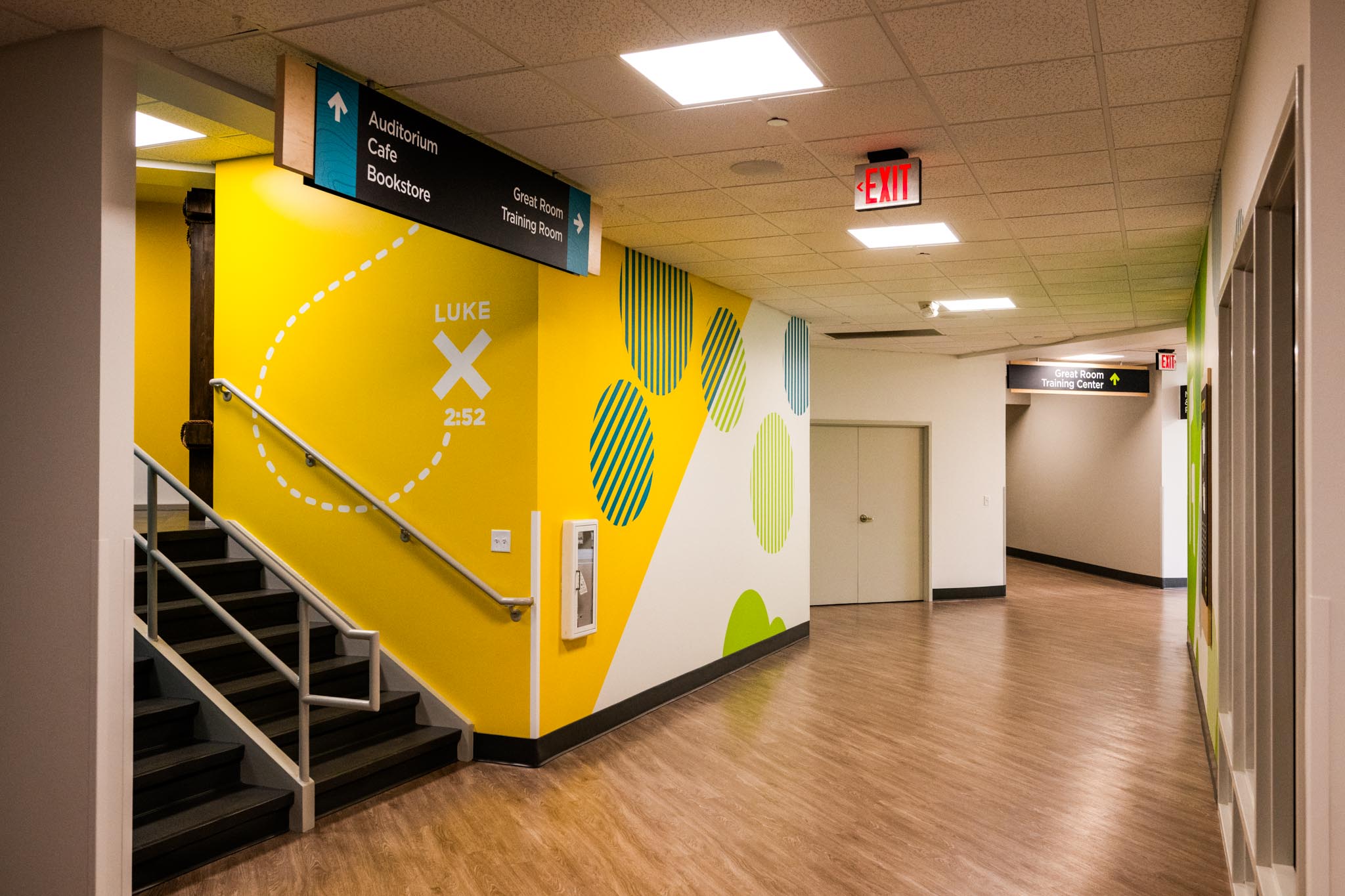
Granger Community Church’s Kids’ Ministry
Know Your Community Before You Touch the Floor Plan
All of this starts before a single design decision. Not “what do we want our building to look like?” but “who are the specific people we’re trying to reach, and what story are they already living in when they arrive?”
Your church has a neighborhood and specific people with specific struggles. PlainJoe’s connected storytelling approach ensures that every design decision, from site orientation to square footage to signage, is a chapter in the same story, speaking to the same people, reinforcing the same message. Not a collection of individual choices, but one coherent narrative your congregation and new visitors experience from the moment they pull into the parking lot.
The question isn’t whether your building is going to tell a story; it already is. The question is whether you’ve been intentional enough to decide what it says. PlainJoe’s Story Circle is the right starting point, a discovery process that surfaces the community insights driving every design decision before a floor plan is touched. Reach out to learn more.
Zach Miller is a Project Director at PlainJoe, A Storyland Studio, a multidisciplinary design firm helping churches and mission-driven organizations tell better stories through branding, environmental design, and built space.

